





Robotic Grinding—Ready for Prime Time
August 25, 2023Comments
Technology now allows for giving robots the “human touch” in metal-finishing operations, leading to success in robotic-grinding applications, as this automation integrator explains.
Automation certainly has inundated every facet of the manufacturing landscape, from raw-material delivery to the finished part, component, assembly or product out the door—we see examples of this in every issue of MetalForming. For a variety of reasons, finishing processes always seemed to lag a bit behind on the automation train. Grinding and other finishing operations, often tedious, strenuous and fraught with the potential for ergonomic and other safety hazards, present so many variables that automating can be quite challenging—finishing is no low-hanging fruit for automation. But, with advances in machine, sensoring and analysis technology, automating finishing operations is becoming a more-common reality, delivering quality results while freeing manual labor for other tasks.
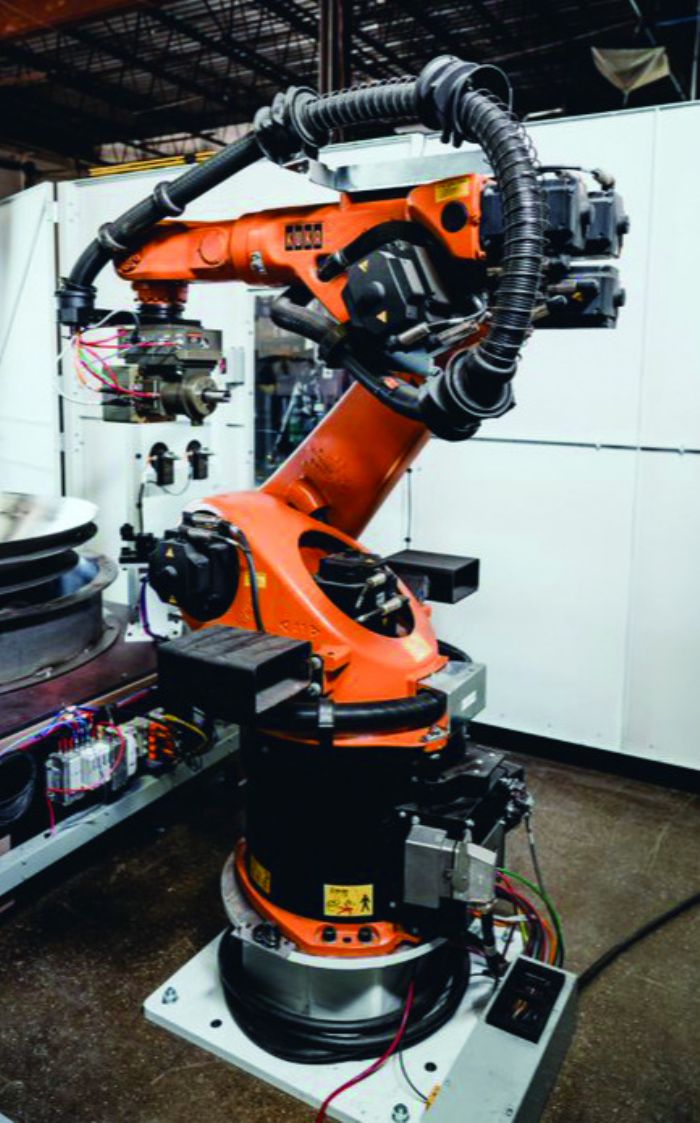
That is how Ben Graham, senior consultant of Factory of the Future Services for Invio Automation, sees it, and he should know. Invio Automation, with some 500 associates across nine U.S. locations, designs implements and sustains automation for operations worldwide. Here he shares his thoughts on the automation evolution in finishing, using a case history resulting from Invio Automation’s relationship with Kuka Robotics to illustrate finishing-automation success.
 “Finishing is one of the more difficult processes to automate,” Graham says. “Material handling—as in moving product from point A to point B—is simple for a robot, but grinding and sanding lack clear ways to quantify and define pass and fail criteria. Surface-finishing processes tend to be carried out by a small number of skilled workers in the factory, each of whom having a different standard on what constitutes a passing part.”
As an integrator, Graham describes Invio Automation’s role as aligning with metal formers and other manufacturers upfront on what criteria constitute a passing grade on the finishing process. The criteria then drive abrasive selection, cycle time and robot pathing. With these process parameters in place, Invio Automation then works to compute the project payback based on labor savings, safety improvements and improved product quality.
“Automation has a cost, so the savings must justify the initial investment,” he explains. “Savings can result from decreases in headcount, reductions in workers compensation premiums that are common for these taxing operations, reduction of scrap by standardizing the process, increased throughput and overall higher product quality. The business case for automation is multi-faceted and often extremely compelling compared to other areas in the plant.”
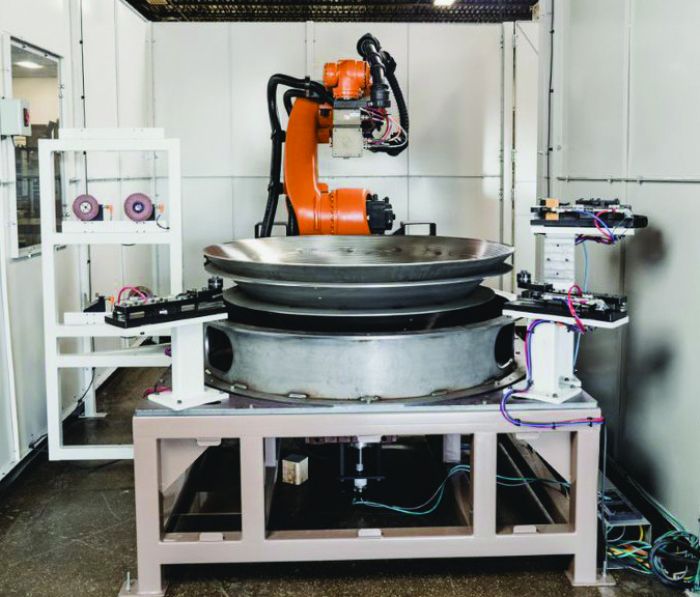 To provide insight on effective robotic-finishing solutions, Graham details a recent Invio Automation project designed to free a U.S. agricultural-part producer from the “three Ds” inherent in manual grinding: dull, dirty and dangerous. The spun-metal part in question—bowl-shaped—had required manual grinding via one worker per shift across three shifts—three full-time employees dedicated to the task. Specifically, the part producer sought to eliminate the safety risk presented by this manual process while creating a repeatable, scalable process versus the previous artisanal process that depended on a small number of highly skilled craftsman. A successful robotic-finishing solution in this particular application had to meet two fundamental challenges: grinding in multiple planes—vertical down, horizontal and everywhere in between on the bowl ID; and dealing with the fact that metal spinning can deliver parts with some level of surface variability where a grinding medium must maintain consistent part-surface contact despite imperfections.
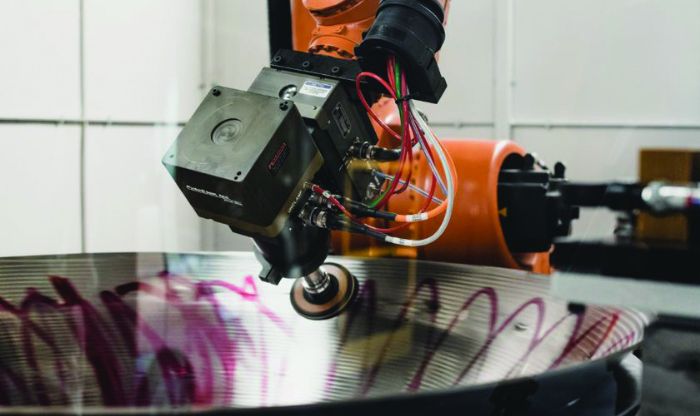 In this particular application, a worker manually sets the piece within fixturing on the worktable, though metal formers can opt for automating part placement and removal. In operation, the robot grabs specific end-of-arm tooling containing the selected abrasive wheel and performs grinding on the part surface, and changes out the wheel as needed—time-based in this application—depending on the finish desired. By working with the metal former, Invio Automation and other team members, through testing, determined the type of abrasive wheels needed, the sequence of their changeout and the time required for operation of each wheel—a key challenge of the application and a complex component of robotic-finishing automation.