





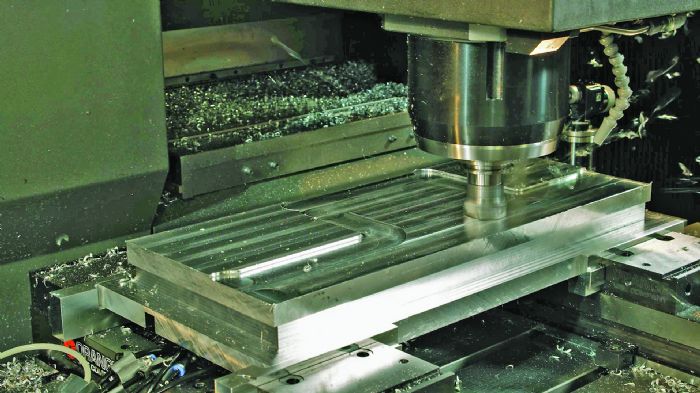
 As a result, automakers engineer complex cooling systems for battery protection. Most systems feature a battery container or tray with a network of tubes or channels that circulate coolant around the cells. The trays usually are located low in the vehicle and in some cases fill the entire underside of the car from the front to rear axle.
Hybrid Milling/Welding
An optimal solution for battery-tray manufacturing would be a hybrid process that combines the FSW process for assembling the cover to the milled battery tray. In such a case (the Mazak MegaStir process, for example), an intelligent tool holder mounts in the spindle of a vertical machining center that performs normal tool changes between a milling cutter (or other cutting tool) and an FSW tool holder. Fully closed-loop FSW software allows for real-time process monitoring, manual thrust-offset capabilities, process logging and part-program design, all at the machine control. An operator then can manage the three main FSW process steps—plunging, traversing and extracting.
The combination of FSW and subtractive machining creates a highly productive, lean, and hybrid multitasking platform, able to machine and assemble components in one setup with one operator. The FSW/subtractive machining hybrid operation facilitates prototyping and full production operations. Prototype shops can create a design, machine and weld the assembly, as well as finish-machine it all on the same piece of equipment with minimal setups.
The hybrid platform also enables commercialized high-rate production. If a product is designed to exploit the advantages of the hybrid manufacturing process, manufacturing speed increases by multiples. A part that theoretically might take 30 hr. to machine can be built in 1 hr. with hybrid multitask manufacturing.
The size of products that can be processed with hybrid multitasking is limited only by the size of the machine tool. “Most battery-tray applications use sheet metal in the range of 1⁄16 to 1⁄8 in. thick,” says Mazak general manager Dale Fleck. “The worktable of Mazak’s VTC 800 machine, for example, is long enough to handle an entire axle-to-axle battery cooling tray for an EV.”
Beyond Battery Trays
The advantages of the hybrid multitasking system in EV manufacturing extend beyond battery trays. Housings for electronic components such as control modules and transmissions can leverage the benefits of combining FSW with subtractive machining and provide a competitive advantage in the high-demand EV market.
Further, many other industry segments, including aerospace and medical products, and even household appliances, seek compact design and weight saving to increase efficiency and economy. As manufacturers become aware of the benefits of the hybrid process system and learn how to apply it, the range of applications will continue to grow. MF
Article provided by Mazak Corp.; www.mazakusa.com.
View Glossary of Metalforming Terms
Technologies: Welding and Joining
Comments
Must be logged in to post a comment. Sign in or Create an Account
There are no comments posted. Welding and Joining
Partnership Promotes AI-Powered Welding Automation
Wednesday, May 7, 2025
 Welding and Joining
Offline Programming for Miller’s PerformArc Robotic-Welding ...
Friday, March 14, 2025
Welding and JoiningMiller Electric and Novarc Partner to Bring AI to Cobot Weld...
Tuesday, February 25, 2025